SeniorSaferHome

Rollator vs. Walker: Which Does a Senior Actually Need?

Rollators roll and have a seat; standard walkers must be lifted and give more support. A plain-language guide to which suits your balance, stamina and home.

The short answer

Choose a rollator if the limit is stamina — it rolls continuously and gives you somewhere to sit. Choose a standard walker if the limit is balance and you need to lean your weight on the frame, because a rollator can roll away from you when you push down on it.

As an Amazon Associate we earn from qualifying purchases. Learn more.

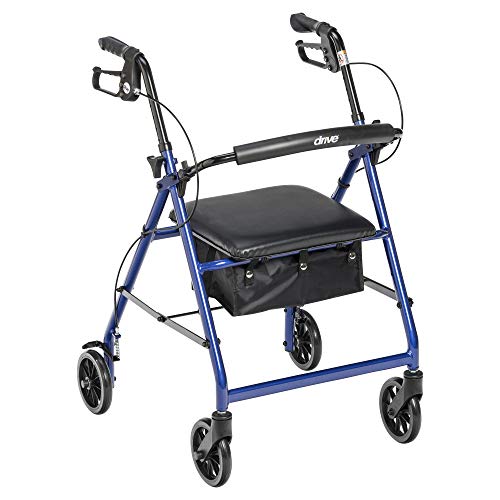
Drive Medical Aluminum Rollator: Best when stamina is the limit and you need somewhere to rest.

Best Bariatric
Medline Bariatric Heavy-Duty Walker (500 lb) — The highest-capacity pick at 500 lb, with an extra-wide 20.5-inch frame and easy two-button folding.

Medline

Medline Bariatric Heavy-Duty Walker (500 lb)

4.6(2,193)

The highest-capacity pick at 500 lb, with an extra-wide 20.5-inch frame and easy two-button folding.

  • 500 lb capacity
  • Extra-wide 20.5" frame
  • Push-button height 33.5-43.5"

Medline Bariatric Heavy-Duty Walker (500 lb): Best when you lean weight on the frame for balance.

Head-to-head comparison

How it moves

Drive Medical Aluminum Rollator
Four wheels, rolls continuously without lifting
Medline Bariatric Heavy-Duty Walker (500 lb)
Lifted or pushed in short stages

Weight bearing

Drive Medical Aluminum Rollator
Not for leaning hard on, it can roll away
Medline Bariatric Heavy-Duty Walker (500 lb)
Designed to take real weight through the frame

Somewhere to sit

Drive Medical Aluminum Rollator
Padded seat and backrest built in
Medline Bariatric Heavy-Duty Walker (500 lb)
No seat

Brakes

Drive Medical Aluminum Rollator
Hand brakes that lock for sitting
Medline Bariatric Heavy-Duty Walker (500 lb)
No brakes needed

Indoors

Drive Medical Aluminum Rollator
Wider, harder in narrow hallways
Medline Bariatric Heavy-Duty Walker (500 lb)
Narrower, easier through doorways

Typical user

Drive Medical Aluminum Rollator
Walks fine but tires quickly
Medline Bariatric Heavy-Duty Walker (500 lb)
Unsteady and needs support at every step

Frequently Asked Questions

Neither is safer in general, they suit different problems. A rollator is safer for someone whose limit is stamina, because it keeps them moving and gives them a seat before they get exhausted. A standard walker is safer for someone with genuine balance loss, because you can lean weight on it and it will not move. Using a rollator as a weight-bearing support is the dangerous combination.

No, and this is the most common misuse. A rollator on unlocked wheels rolls away when pushed down on, which is how people fall while using one. Always lock both brakes before sitting or standing, and use a fixed grab rail rather than the rollator when rising from a chair or toilet.

A standard walker is usually easier indoors. It is narrower, turns in place, and clears tight doorways and hallway corners that a four-wheel rollator has to be reversed out of. Many households end up with a walker for indoors and a rollator for going out.

If the reason for buying is fatigue rather than balance, the seat is the main feature and not an extra. Being able to stop and sit for two minutes is often what turns an impossible walk to the shops into a routine one. If the user never sits, a lighter seatless rolling walker may suit better.

Watch how they hold furniture at home. If they touch surfaces lightly for reassurance, a rollator is likely right. If they grip and push down to hold themselves up, that is weight bearing and points to a standard walker. An occupational therapist or physiotherapist can assess this properly, and in many places the assessment is free.